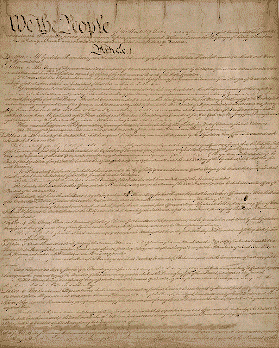
The First Amendment
"Congress shall make no law respecting an establishment of religion, or prohibiting the free exercise thereof; or abridging the freedom of speech, or of the press; or the right of the people peaceably to assemble, and to petition the government for a redress of grievances." |
The Constitution
How the first amendment was written:The following Spring, Philadelphia PA hosted the Constitutional Convention. They resolved three main religious controversies. They:
|
* decided that there would be no religious test, oath or other requirement for any federal elected office |
|
* allowed Quakers and others to affirm (rather than swear) their oaths of office |
|
* refrained from recognizing Christianity or one of its denominations as an established, state church. |
But there was no specific guarantee of religious freedom.
Jefferson was pleased with the constitution, but felt it was incomplete. He pushed for legislation that would guarantee individual rights, including what he felt was the prime guarantee: freedom of and from religion. Madison promised to promote such a bill, in order to gain support for the ratification of the constitution by the State of Virginia. In 1789, the first of ten amendments were written to the constitution; they have since been known as the Bill of Rights.
|
|
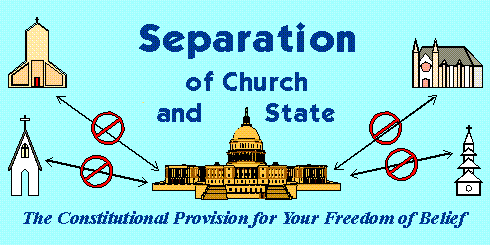
"Wall of Separation" between Church and State
Thomas Jefferson, as president, wrote a letter to the Danbury Baptist Association of Connecticut on 1802-JAN-1. It contains the first known reference to the "wall of separation". The essay states in part: "...I contemplate with solemn reverence that act of the whole American people which declared that their legislature should 'make no law respecting an establishment of religion, or prohibiting the free exercise thereof,' thus building a wall of separation between Church and State..."
During the 1810's, President James Madison wrote an essay titled "Monopolies" which also refers to the importance of church-state separation. He stated in part:
"Strongly guarded as is the separation between religion and Government in the Constitution of the United States, the danger of encroachment by Ecclesiastical Bodies may be illustrated by precedents already furnished in their short history."
The US Supreme Court has interpreted the First Amendment as if it requires this "wall of separation" between church and state. It not only prohibits any government from adopting a particular denomination or religion as official, but requires government to avoid any involvement in religion.
|